We specialise in technologies that deliver effective and smarter ways of doing business. We focus on using social platforms and tools to improve marketing and internal communications.
www.tribalcafe.co.uk
Socialnomics by Erik Qualman has had a refresh and some new material added in which is well worth watching. The original version has had over 2.8M views, the 2nd video over 1.6M and doubtless that this one will achieve a significant number
Idea: many people have in there own business/market or vertical amazing figures that are often not pulled together or are not even known. If you want to to create something interesting for your industry why not explore this type of infomercial video for your industry. I appreciate in many cases it might not work but in some I imagine if done well it would spark a lot of interest.
Some more resources for social media facts and figures:
The BtoB Guide to Social Media guide have put together a massive list of facts and they are continually updating this as well. They have categorized the list so fairly easy to explore figures for any blog or article you are writing.
Data can be pretty tough to get your head around especially if you like to see information more visually. However, infographics can take data and present it in visually stunning ways. It has become a captivating way of explaining often complex data in a brilliant and creative way. The daily infographic has some good and easy to view categories for you to search. Importantly infographics can be a key hook and provide traffic and buzz.
Supplement you blog or an article with a good infographic it will help illustrate your article and break up the text.
Facebook
So much news and focus in social media is around Facebook. The growth of Facebook has been phenomenal and it continues to dominate the social networks not only for the size of the user base but because they are still evolving and changing. Brands and businesses are switching budgets to focus more on developing their brand communities on Facebook and it is no wonder when you look at how many followers some brands have.
Some of the best figures come from the research and reports that are generated by the specialist consultancies. Many are more of a generalist research consultancy such as Forresterand Gartnerwho produce industry and market reports that many organisations buy. However, often the data or at least some of the graphs filter through and can be picked up for free. Hubspot produces some excellent reports and most are free to download in return for signing up to their subscription.
On the flip side consultancies likeEconsultancy through their blog release some great insights and reports. Other noteworthy consultancies are Borrell Associates and
Add to this blog
If you have any other resources or websites that you think are good and are worth adding to this list let us know and we will update it with your information and of course credit you with any links you provide.
There are probably many different definitions and variations on what a social business is. I don't want to get bogged down in semantics. What I am passionate about is the way people can can come together to share, learn, collaborate and benefit from embracing the principles of social business. It is the transformative impact it can have both culturally as well as operationally.
When I listen to people and views on the net there are people that talk about changing behaviors - focusing on how people's habits have changed, how they interact, where and how they spend their time, that people are sharing information socially, how they buy, who they trust, how they find information, how they interact...Others seem to focus on how the technology is changing people's behaviors enabling new ways to interact, collaborate, communicate, share, connect...and a few even mention culture.
We need to recognize that Social business is about people, technology and culture and one without the other doesn't work. Organisations that just embrace the technology of an enterprise 2.0 vendor selling them a community platform will not work. Neither will someone developing a strategy for cultural change without the guidance on how to implement and manage the change process. Equally overlaying a social business strategy on a culture of fear and hierarchical management control will fail.
The idea of having to adapt and change is as old as business itself but the need to change rapidly is now a necessity and a source of competitive advantage. Customers are changing and new business models are emerging thanks to flexible and social and scalable technology solutions.
Organisations are now tackling how to integrate social technologies into their business beyond the use of marketing or customer service. However transitioning to new working practices is not easy for many as they move from old legacy systems to new (often requiring intermediary stages), aligning goals and objectives, aligning roles and responsibilities, changing processes as well as leading the change.
We can look at how Dell and other organisations have focused there efforts on taking small digestible steps, piloting projects, developing champions and building on their learning.
One aspect though is consistent it is the pace and need to change and learn, to adapt to become flexible to the dynamics of a new and emerging era.
Focus on the application
Organisations who want to adopt a social business approach need to focus on the application and relevance to the business. There are a multitude of ways applying social solutions improve a business. However, each business is different and how and what is a priority will depend on the organisations strategy, goals, objectives, market position...What is important is to identify the opportunities prioritise them and start.
I call this the age on your imagination because you are main limitation in coming up with business ideas and solutions is no longer the technology.
Key take outs
Research your market and identify how your market, customers, competitors and business models are being affected or could benefit from social business
Identify some tangible projects
Research your employee capabilities
Bring together relevant stakeholders
Scope your projects and enable your team to make decisions
Communicate, communicate and communicate - be open
When talking to businesses they often have difficulty in understanding the value of having a blog. Many just feel obliged to have one because their competitors do or they were advised to by their web developer. Yet used well blogs can significantly improve your social business presence, SEO (providing fresh content and relevant SEO keywords) as well as being a powerful marketing tool.
However, many businesses are making some common mistakes that could simply be avoided. In a tough and competitive market it is important to focus on marketing your business and to do it better than your competition. A blog is ideal for BtoB and integrated well into your social business strategy can yield great results. Here are the 6 ways to improve:
Writing a blog that focuses on your target audience
Starting your blog (or post) by conducting some research
Identify how you can add value to your customers
Use a good layout to make it visually appealing
Use a variety of media and material (not all yours)
Harness your people to help develop your blogging
1 – Writing a blog that focuses on your audience
Can you explain to someone who your target client is? Segmenting your customer is important to identify the types of customer you are trying to reach and will help when you think about your strategy. Different markets will have different issues, topics of interests, news...
Identify and segment your customer(s)
Imagine you are them and write down a profile of them their likes, responsibilities, issues...
Decide on your strategy - what is the purpose of your Blog, how do you want to be seen, what value will you add to your customers
Use keywords: not only for SEO so that you will be found by customers but also to help you focus on your writing and research
2 – Starting your blog (or post) by conducting research
Many of your existing or potential customers may be blogging as well as some of your competitors. So it is worth spending some time researching and getting familiar with what has already been written about and what you competitors are focusing on. It is very important that you’re not just repeating what someone else already said. To research and find blogs here are some useful links:
After reading a few you will also see what is topical, popular and being shared. Make notes and come up with your own ideas for how you can contribute to subjects in your industry.
3 – Identify how you can add value to your clients
Add value to your customers:
demonstrate an authority within industry e.g. demonstrate analysis or evaluation of market
add value to your customers – help them with useful information
contribute to thought leadership with any topical news in your industry – opinion piece
provide insights into their market that can help them e.g. summary of market reports and key actions they should take, your own market research...
Some ideas:
Organise a focus group meeting with customers to discuss issues in the market and what difficulties they are facing
Listen to the customer conversations on forums, social channels e.g. Twitter and identify those that have high rates of interaction - what subjects are your customers interested in
Produce a short list of topics and then rank them in order of how your business can add value to those issues through the knowledge, ideas and experience of the people in your business
4. Use a good layout to make it visually appealing
When I started to write I hesitated over the title, why? – most people’s first thought is probably to use the word write but I think a good blog is a production.
Blogs are increasingly a collage of media pulled together to help readers connect with the narrative as well as make it easier to illustrate your points. We know that a picture can paint a thousand words and well a video (or animation) can help us understand a lot more.
avoid filling a page with text only
use images in a blog to help explain pieces add humour or illustrate a point
add interactive media - research to see if there are any good slides on the subject on SlideShare (not competitors) or use your own in the blog and/or add a relevant YouTube video
simple but structured layout - structure, visually appealing, illustrate points
5. Use a variety of media and material
Don’t just write about your business. But your blog shouldn’t just be all about your business, not if you want people to keep coming back. You’re writing for an audience. Incorporate their questions, their concerns, their issues and those of the market.
Refer to experts - reinforce points by referencing other people blog posts from your market
Refer to articles in the press or market media e.g. magazines, news items...
Refer to customers - if you think a valued customer has a good point to make phone them: tell them you are writing a blog and you would value their input and if they are OK for you to quote them (you will make them feel valued)
6. Harness your people You have the opportunity to post more frequently, harness more experts and provide a varied and more interesting range of content, if you use your people to blog.
Ask people to write a blog - initially select a few people in your business to help with writing a blog - by sharing this you will be able to blog more frequently and provide different views and perspectives on your industry
Be individual - everybody is different and has their own take on things, language and so each person may appeal to different audiences. Let people be themselves and don't exert too much editorial pressure.
Become an editor - different people will have different ideas so you will have to place some guidelines on blogging, provide some structure to the process (schedule, meeting dates, submission dates, topics) and meet as a group to evolve and improve
Measure - put in place some clear objectives as a team and measure them regularly; build into your marketing plans and review as a team.
It can be extremely motivating and personally rewarding for people to contribute to blogging. Be patient and share mistakes and learnings. If you are recruiting and people can see that you are openly letting people have their own voice and using social business tools it will allow people to understand your business and be inspired to join.
The last and obvious point is to ask your audience for feedback and this is where I would love to hear from people if they are in a BtoB business:
have had success with blogging (please share so others can learn)
have problems and want any advice (I will reply to everyone that comments)
Ask a young person with a smartphone to order a pizza or takeaway. The chances are they won't turn on their PC; they might look for a ragged favourite menu stapled to their kitchen wall or they may simply and intuitively pull out their smartphone and search. In a similar vein whilst looking to buy a printer in a large store, I saw people pulling out their smartphones and checking prices online and yes I did it to; the store in question said they would match any price (why not then).
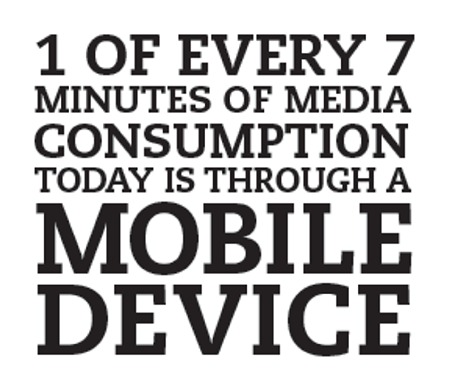
The mobile (smartphone) is transforming how we interact offline whether that is searching for services, brands or prices - we do it when we want, wherever we are. It is our access point to our social networks; our key communication tool.
If we add into this mix check-ins e.g. Facebook, ShopKickwe can see how our online moments intersect with offline. Social commerce is not just a Facebook store or Facebook Open Graph integrated into a website; it is the influences upon our buying decisions.
Pre-sales: e.g. search, reviews, comments, likes
At the point of sale: e.g. offers, coupons, group buying
Post sale: e.g. sharing, commenting, rating
People are no longer shackled by access to the internet via a PC, it can be in the moment - it is real time interactions that will become increasingly important providing more relevance than before.
What will change this significantly is the integration and convenience of being able to pay using the mobile phone:
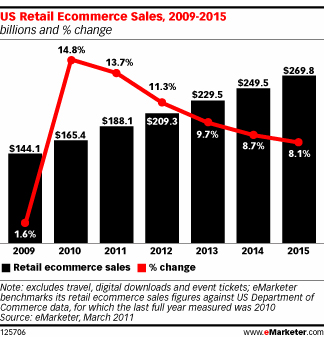
Here are some of the figures that demonstrate the continued growth of online:
The research firm Forrester projects online retail sales to increase to almost $250 billion by 2014. That’s a big number, but still a small piece of the retail pie at just 8% of U.S. sales.
Here are some interesting inforgraphics that support the changing dynamic of the social customer:
Infographic illustrating the trend in online retail sales
An infographic on the development of Social Commerce in 2010
I’m fascinated by the impact of emerging technologies and how they influence economic variables across the media, marketing, information and entertainment ecosystem. In particular it is how the online and offline experience will integrate as brands seek to differentiate themselves.
If we take a look at retail we can see that at the moment it has several persistent problems: the high cost of attracting visitors, the low probability that they become buyers and the difficulty of getting them to come back. Sociable e-commerce offers potential solutions to all of them. So both brands and retailers must integrate their touch points to access customers.
Social business tools create experiences
It is no longer about channels; it is about the customer life cycle across everywhere a brand touches them. This involves orchestrating the customer relationship across touch points, not channels. It is mobile though that will bridge the gap between online and offline experiences, challenging marketers to connect the dots through creative solutions that match consumers’ mobile consumption habits. As brands give birth to creative ways to engage people their responses and conversations will also change how engage, brands will behave more like people and consumers will more than ever assess brands as they would people.
Is it Just about Facebook?
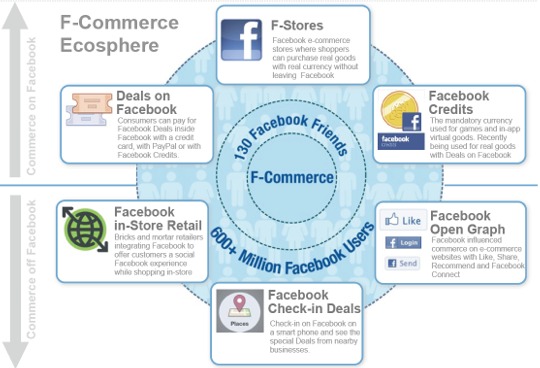
Facebook has extended its reach beyond the platform so that websites can integrate Facebooks Open Graph e.g. the 'Like' and 'Send' buttons. Facebook’s business functionality will continue to evolve. Eventually, social elements will cross each function of business. Those businesses that are early to explore these methods will dominate what could become the largest market place: Facebook.
This illustration from Horizon Studios demonstrates the dimensions of Facebook commerce
Social Commerce
As e-commerce retailers continue to pop-up and online shopping becomes even more prominent, people will increasingly become more and more comfortable sharing transactional items like clothing, daily deals, books, and electronics as more of their purchasing decisions are made online. For the new generation of e-commerce firms, the offline world is as important as the online one.
New social platforms like Swipely will gain popularity.
Data the Oil of Commerce
Facebook captures vast amounts consumer data and this rich seam of data links personal data, network associations, transactions and location. It will drive yet further ways for brands to understand their customers. The very nature of the feedback mechanisms built into being a social brand provide the ability to fine tune product development, accelerate innovation and harness new technologies to drive engagement.
The potential to harness this data to deliver targeted, personalized shopping experiences for brands, is huge.
What are the building blocks
Businesses need to start small and simple-piloting, experimenting and reworking until successfully determining how to transform themselves into being social and agile businesses. Businesses that embrace this change to social commerce will reap the benefits of differentiation, reduced customer acquisition costs, lower service costs and faster time to market.
1. Integration
Get your channels in place. Set up Facebook and Twitter profiles – these are the main players.
Develop a mobile website, this is increasingly important and most websites do not render or work effectively on a mobile.
Use your mobile website to offer promotions, QR codes…many mobile website solutions like ours allow you to control this through a Content Management System that is easy to use.
‘Socialise’ your website: add social media sharing links to your website.
Make it easy for people to share integrate social sharing with social sign-on so that items can be shared with the least amount of friction.
2. Facebook Page
Develop your Facebook page and build you fan page. If you haven’t established a Facebook page yet then don’t just rush in and commission a Facebook store you need to initially test and build you presence on Facebook, make sure it works for you.
Commission a branded landing page. Actively promote your products, promotions and discounts using email, Twitter and Facebook.
Understand how social your customers are: listen and engage customers to see how they react. Social is not for everyone.
3. Extend your capabilities
Enable sharing with friends before buying – to allow customers to crowd/friend-source advice on whether to buy.
Use a Social Shopping Cart which allows people to shop and share with their friends via Facebooks social graph.
Integrate Facebook comments into products; customer feedback is the essence of improving your range and products
Don’t just sell: social commerce shouldn’t be all about selling – add value to their customers’ shopping experience – and give them a reason for communicating with you and their peers.
Create a dialogue with customers who want to talk to you. Use your blog and social channels to do this.
Use your Facebook wall like it’s your shop window but don’t only broad cast – use it for feedback. Openly encourage customers to have a say in the business – by crowdsourcing decisions it will encourage how they promote you (word of mouth initiatives)
Integrate your customer service strategy with your social media strategy – diffuse situations by helping customers directly through social media.
4. A Facebook Store
Investigate bespoke solutions turn your Facebook account into a fully functional e-commerce platform.
Use Facebook contests that request “Likes” to automatically send users to the Facebook store to encourage product browsing.
Integrate your marketing and inform your current customers where to find your store and how it works.
Use the Facebook Fans API to combine promotions with links to product detail and purchase pages within the Facebook store - this enables brands to collect profile data. Add product videos – and host them on YouTube.
5. Promotions
Have a clear strategy and timetable promotions, make it varied and keep It interesting.
Don’t simply discount. Use virtual rewards as well as monetary ones - reward your fans with exclusive discounts and promotions.
Form alliances or partnerships with local businesses where you have synergies to promote each other.
6. Measure
It is important to use a number of different tactics to drive traffic to your website, develop referrals from social media and use offline tactics.
Measure and track how effective each is and use the information to refine and improve your marketing.
Use Facebook analytics to understand who is buying, who is being converted – use it to refine your marketing approach.
What do you think will be the deciding factors for being successful with online?
Integrating touch points
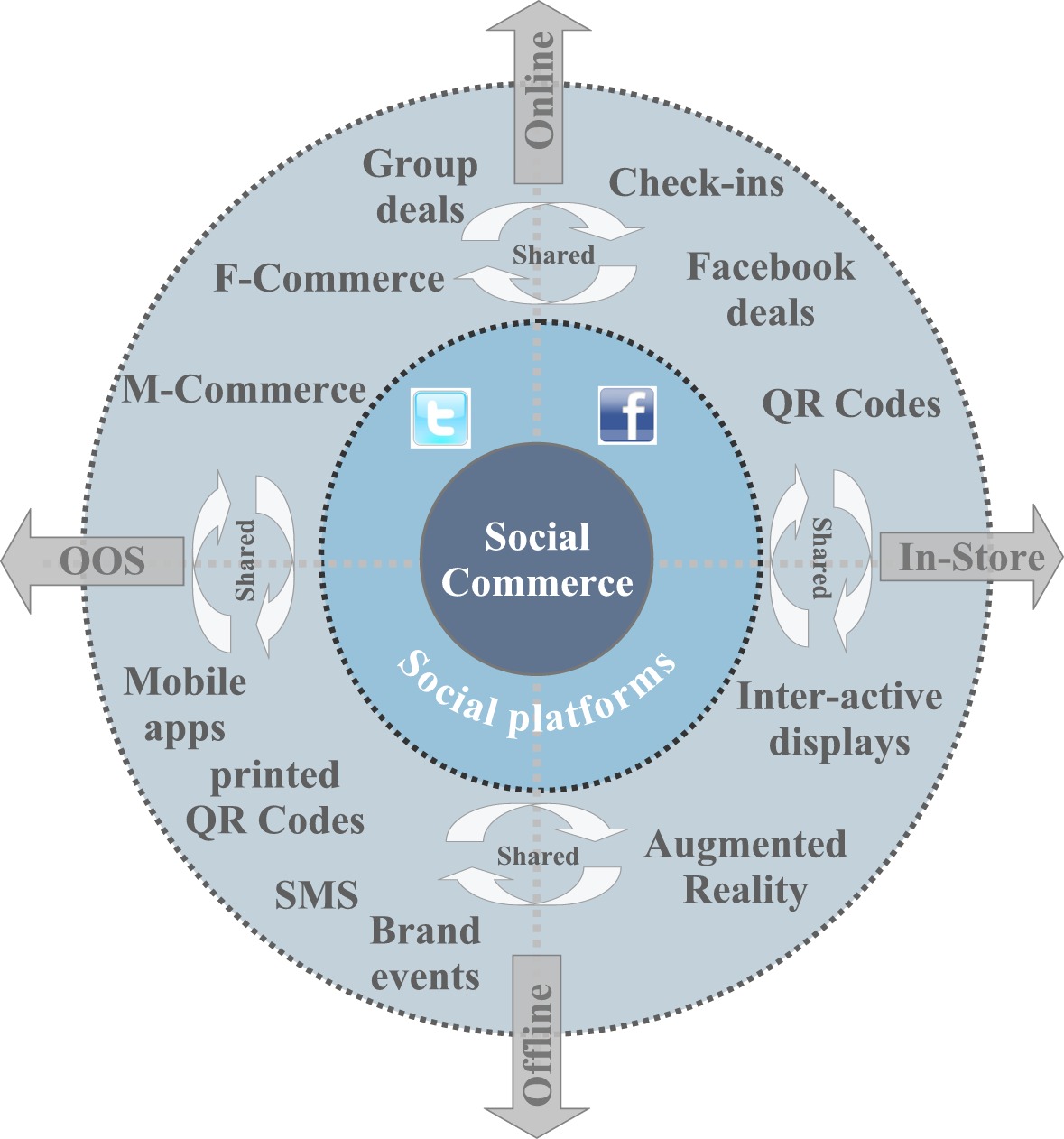
We produced a rough illustration of how some touch points and technologies integrate; it is not a model so much of an example of how each can play a part in how a business can use mobile, social and emerging technologies.
The Offline Experience
We can see how offline (this may involve connected devices but not your own 'device') experiences propagate online:
1. Define your strategy and then conduct research to understand how you can add value to your customers. This need not be hard and you can get some valuable information without it costing too much. Form many small businesses this can involve preparing a simple questionnaire and inviting existing or potential customers to meet up for breakfast, lunch... and discussing it with them. You will often be amazed at what you find out.
For larger businesses studying customers on-line can help. Digital ethnography (studying on line behaviour) now provides a wealth of information and access to customers and is often easier than offline research:
social networks allow us to visualise relationships,
people are more honest when they write behind a pseudonym
respondents have control over what they share
researchers are less obtrusive and less likely to affect the behaviour of the people they are studying
Strategies need to build sustainable communities rather than sporadic isolated campaigns
2. Too much data is no good to anyone. You need to focus on simple concepts and then build upon them to produce your creative concepts for marketing. Keep it simple, easy to understand and measurable. Test it on a small group of customers get feedback and then scale. Content then becomes relevant and of value to your customers and more importantly has a far higher chance of being shared.
Create relationships, drive conversions and deliver sustainable and profitable revenue growth.
3. Be consistent in how you deploy your communications. Reinforce your communications around your creative concept so that they reinforce your idea rather than dilute it. Make it interesting, an experience and build on the emotions; for it is the human touch that matters the most - this is what we share.
Reinforce and co-ordinate touch points to ensure the sum of the parts are greater than the whole
Linking Research to Value
Ultimately by using research the aim is to add value to a customers experience of your brand. Rory Sutherland provides some humorous insights into how advertising has traditionally gone about building intangible value. The reality for brands now is that value is being reshaped by our relationships and our networks. (If you only watch one thing see the interviews for diamond shreddies 13mins - very funny)
Change the Perspective
The simple truth is that research allows you to make better decisions about the creative concepts and content that you use to market your brand.
However, many businesses simply throw their money away when it comes to marketing. They certainly don't intend to, but too often many make assumptions about their customers that are simply wrong.
But this is an over simplified explanation of what happens, for quite often there is a recognised need for data, but accessing it and relating to customer profiles is difficult. The reasons for this can be many, not least is the problems of knitting together data from disparate data sources (customer service, promotions, email marketing...) to form some level of customer segmentation.
From the many different views it is hard to pin point who the customer is and how their behaviours relate to your product; in short there is little available data that can form the basis for insightful decisions. The truth is the impact of a poor customer data management strategy goes beyond missed sales opportunities and links directly to the profitability of an organisation.
Taking a Bet
As a result many marketing directors gamble on assumptions that form the basis for creative ideas and concepts; which in themselves might be brilliant but simply do not bear any resemblance to the target customer.Yet most people shrewdly research and investigate suppliers before spending their own money. Why not then apply the same principal to customers.
Why does this matter so much?
Knowing your customer and understanding their needs forms the basis not only for marketing but also product development, customer service...it is at the heart of how well you serve your customers that determines how well you compete.
How and where we tell out stories has shifted, but they are the same stores. We now use our social networks not only to share these stories but to listen and participate in making them. As a result research has never been more powerful or more cost effective and can be used to improve decision making.
We must use new research technologies because technology itself is changing the way people move through life and transact their work. Part of the change involves privacy, mobility, and communications modes. People are harder to connect with, period: less use of land lines, heavy phone screening, growing perceived value of time, and more. In a word, people are more reachable and open if the marketing research technique fits with their lifestyle.
You can use this space for your brand to allow you users to quickly recognise you. This is the image that shows up when people search. It can be up to 180px by 540px, but if you do this then make sure your main logo fits right for search.
Once you’ve done that, you can turn your attention to the new photo strip. At the moment you can't control where each of the images (they need to be 97px * 68px) that are in that strip will go – they are randomly sorted by Facebook. They can’t be ordered like they can on personal profiles.
Top tip here is to use images with a similar design so they create a more uniform look. Alternatively you could use QR Codes or Tag to go here as well; offer your customers specials or exclusives - it is one of the biggest reasons people visit brand pages.
B - The Tabs
Each tab can now be linked to an icon which makes it visually easy to differentiate tabs. Our tip here is to keep it tidy - delete old tabs, keep a menu that is relevant and label them clearly. If a tab is not being used change the content, question if it is needed and if not remove it. We often see tabs like discussion with no posts, events with no events...keep it simple and up-to-date.
C - The Heart of the Page
This is the biggest part of the page and where you are looking to interact and engage your fans. Some key points:
Point out the like - don't forget to remind people to like you
Share - the share button invites people to share your page with their friends
A word of caution here, don't get absorbed in the tools - understand your customers, research their interests, passions and behaviours and you will then produce content that is relevant and engaging for them. Once you've decided on this the content production and delivery follows naturally.
Most brands now are using video on their pages to entertain / engage / interact with their clients. If you look at this link you will see that video is becoming interactive. The point is you can integrate virtually anything into Facebook now, graphics, copy and even e-commerce.
Use a video to:
make a personal commentary about your business or products
provide some interesting ideas that you are working on and ask people for their comments/feedback
provide testimonials of happy customers and why they use you
video interviews of why your people like working with your business
you can also use motion graphics or animation here to explain your products or services in an entertaining way
You can even get people to try your new products!
D - Make it Easy to Find your Brand on Other Social Sites
Coca Cola also highlight their other networks - something few brands remember to do. You don't have them exactly in this position but remember to make it easy to find and recognise the icons for the other social networks like Twitter. Often this is on the information page which people don't often look at.
E - Make The Page Worth Exploring
People are increasingly spending more time on social networking (nielsen) and Facebook is the dominate player. Providing a a set of rich experiences on your Facebook page means that people spend more time with your brand than your competitors, are more likely to stay on your page and more likely to share your content. Use the page to enable people to explore opportunities.
Don't forget to also offer specials/exclusives to fans. The top two reasons to follow a brand are for promotional benefits (84%) and because the fans already enjoy the product (89%). 83% of fans would like more exclusives from the Facebook page, whether via special offers or Facebook-only content.
F - Highlight and Link to other Products Brands or Partners
If you have other brands/products or services then you can like them as a page; these then show up in the space highlighted as F in the Coca Cola example above. If people like your brand then the chances are they might explore and like your associated pages.
A FEW MORE TIPS
Information page
Take a look at the Pepsi and Nokia information pages. Pepsi has been a bit lazy just duplicating links whereas Nokia have made a clear statement for their followers. Use this space wisely and fill it in to tell people about why they should follow you and how you want to build your relationship with them.
Frequency of Posting
Posting too frequently is the 2nd most cited reason for unfriending a fan page. Most experts recommend 2-3 times a day as a maximum. Here are some reasons as listed on Mashable and some further reading. To see some other great examples of how brands are using Facebook here is a list from Econsultancy.
Rules and Policies
Some brands ignore this and don't put up a clear statement of their policy for their walls. However, best practice is to post up a clear statement that allows people to understand what is acceptable and what is not.
Brand Engagement on Facebook
Here is Jeff Ragovin who gives a great talk on Facebook brand engagement - enjoy :-)
If you have any questions or are looking for advice you can post on our Facebook wall and we promise to get back to you with an answer - you never know by sharing it we may help other people with the same question.
Have you noticed that not all Facebook pages are equal; not just in the presentation of the brand, but the interactive media, the conversations on the page, the comments and likes. In getting a Facebook page to look good there are some basic points you need to consider.
We are going to take you through some key areas of a Facebook page and what to do to make it stand out from the crowd and how to make sure it works for your customers.
Why Facebook is important
Here are the number of fans/likes for celebrities and brands, so you can see the who's who on Facebook popularity - Top pages on Facebook and here are some further figures. Brands are due to increase their Facebook investments to $4Bn this year. According to a new white paper (pdf) from Webtrends:
Websites that do not engage in e-commerce are losing traffic to their Facebook pages at a startling rate
Websites with e-commerce activity seem to sustain traffic in spite of Facebook's influence, but are experiencing drops in unique visits compared to last year - signs of losing traffic in the future to Facebook
This proves a gradual shift in traffic from a brand's website to its Facebook page and hence the need for marketers to closely measure their Facebook activity
Facebook stores are very efficient at traffic acquisition acquiring visitors at no cost through wall posts and establishing a store monthly user base equal to 1-10% of the retailer's fan base
Facebook stores on average generate a 17% social engagement rate (merchandise "likes" and "shares" per visitor)
Facebook commerce conversion rates ranging from 2% to 4% are on par with Commerce websites.
Facebook commerce conversion rates range from 2% to 4% and are on par with e-Commerce Web sites. (avg. 3.4%, according to Forrester/Shop.org).
If you haven't got a Facebook page now is the time to get one. A good start point is to plan how you want to engage with your target audience and here are a few tips on how you can do this.
“The greatest challenge of the 21st century will be managing the productivity of the knowledge worker.” asserted Peter Drucker, the father of modern management.
Whether you are a business owner or a community manager, you will recognise the need to efficient with information. We are all constrained by time and that is our most valuable asset. But being part of the knowledge economy means we need to find, aggregate, filter, select curate and often publish high quality information relevant to our work or interest. We will strive to personalise it and make it relevant to our interests. This is both a personal and business issue and for Enterprises it is estimated that between 16% - 25% of knowledge workers time is spent searching for the relevant information.
Why you need to be a curator?
First it is important to understand the differences between aggregators, curators and indexers. Being an authority and expert in your field establishes a trust and builds your reputation with your customers. By becoming a source for other you build on-going relationship with customers, which in itself helps generate word of mouth marketing and drives important traffic to your site. By harvesting important content from the sea of information and sorting, filtering and producing contextually relevant material you are adding value.
Developing Quality Content
Many of us have tried RSS feeds and "thematic" or "topic-based aggregation" utilizing a selective number of quality sources of published content on specific topics. But TechMeMe and social sites like Digg whilst helpful are still aggregators. The solution to the ever-expanding cacophony of consumer content lies in using the intermediate layer of human filters and the use of ‘smart’ systems (algorithms based on preferences).
“Interacting directly with an automated news engine makes it clear that the human+algorithm combo can curate news far more effectively that the individual human or algorithmic parts.” - Gabe Rivera - Techmeme.
There are many tools to help now but it is how you add value that will separate you from your competition.
Some useful 'aggrefilters'
Clearly we need to be more efficient with tiemly and relevant information and part of this is the ability to quickly assess it as it comes to us. Whilst current tools do not have the 'smart' or learning capability yet, they are some useful tools to try. As curation becomes more important, new solutions are emerging all the time. It is worth exploring which suits your needs best. Often this will be determined by how each tool pulls through information and from what sources e.g. friends vs. blogs.
Scoop.it offers users the opportunity to “be the curator of your favorite topic” by collecting useful and insightful information among from social media streams. You can then publish it to people sharing the same interest. You can setup up topics as themes and then update them as new content is discovered. Content can be added via a bookmarklet or using a post button on the topic page. You can publish to Facebook and Twitter.
PostPost resembles the mobile app Pulse and the iPad app Flipboard but the main difference is that , PostPost is a browser based application. PostPost imports links, videos and photos in real time from your Facebook friends and produces a newspaper display that can easily be adjusted as needed.
Paper.li you can create up to 10 newspapers based on links shared by your Twitter and Facebook accounts. Each newspaper can be distributed via Facebook or Twitter. Paperli is easy to use and provides a nice recap of daily or weekly content. One great way to use Paper.li is to use it along with Listerous which enables you to find a list on almost any subject you can think of. You can take any one of those lists and create a newspaper out of it in Paper.li
You can browse photos from your Flickr streams, stories from Google Reader as well as content shared by your Facebook and Twitter friends, all in Flipboard‘s magazine-style format. You can also post Facebook status updates, tweets and photos from anywhere within the app and easily share favorite content across networks (e.g., share a favorite tweet to Facebook and vice versa).
The Tweeted Times (formerly known as The Twitter Times) is a real-time personalized newspaper generated from your Twitter account. The Tweeted Times aggregates news in your Twitter stream and ranks them by popularity among your friends.
Using Pinyadda you have a customizable way of developing a newsfeed. Users can follow a person, topic, or website, and comment on and share news stories with the Pinyadda community as well as their own social network.
Unlike many others Spotery uses people to edit and filter its top news stories. Spotery is is good at integrating content curation with social news. Visitors to the site can follow the selected news stories, or the follow the live stream of submitted links.
Storify uses existing content from across the internet and gives you the ability to drag and drop elements into storylines. Tweets, photos and videos can be searched on multiple social networks. You can also order the elements and also add text to give context to readers.
How to use the information - your daily or weekly
When thinking about your market and customer it is vital to get to understand the issues and problems that they face with their business. By listening and focusing on topics that concern them you can start to set out solutions that can help them: save time, be more effective, market themselves better, do more for less, help them with market information...
A solution focused approach will separate you from your competitors. Focus on topics and subjects that you can easily research and provide some insight on to help your customers; conduct a survey of customers and produce your own market report. You may also find out topics within your market that are relevant, 'hot' and worthy of your effort. In producing a blog or free reports to attract customers.
Good curated content often saves people time and demonstrates your understanding and/or opinion on a subject. Don't foget to make it your own and add your thoughts and ideas.
If you don't have the time then look for an agency that can help you. Often it costs less than you imagine and you can really make a difference in your own time if you recognise that you don't have the time or resources to produce consistent levels of high quality content.
If you are focusing on your improving you Blog or looking for ways to add value to content, we have for you:
Build a story and invite others to contribute to your ideas. These may be new thoughts around a change in your market, technology or subject. By expressing some ideas, supporting them with some links and content and then asking for input you will develop conversations.
Add and use a mix of media to bring a subject to life. Mix rich media like video's illustrations, infographics...
By developing a case around an opinion, thought or subject you can add links, references, resources and then provide a framework to help people understand sometimes complex ideas and see the bigger picture.
Produce some daily news or weekly summary of things that you have found interesting, topical, illuminating or new and controversial. Mediocrity rarely achieves much so sometimes you need to take a stand or have an angle.
Ask for feedback and find out what people like.
Are you building your story or the story of your customers?
In the spirit of looking for feedback we would like your thoughts on where you think the world of curation, news and content is heading - join in and let us know your thoughts.
Paul Greenberg who blogs on CRM at ZDNet and is author of CRM at the Speed of Light (great read) has been instrumental in sharing knowledge on the rapidly changing and evolving world of CRM. CRM is a business strategy designed to optimise profitability, revenue and customer satisfaction. As social channels have developed so too has the complexity of dealing with the associated volumes of conversations around brands and products. Consumers now have power to voice their opinions openly.
Organisations are now rapidly trying to integrate information into their CRM systems (many of which are old legacy systems such as SAP/Siebel). Kate Leggett provides some practical views on this and the need for organisations to take control. So what is the main debate about?
Many people are frustrated with the many current practices of CRM that fail to deliver a good customer experience. Many can relate to long waits on phone lines, multiple interactive voice response lines, lack of consistency with information...and the list goes on. Despite masses of investment in Siebel/SAP and Business Process Mapping organisations seem to have removed not complimented the customer experience. The drive to reduce costs not enhance the customer experience was the main driver behind many CRM initiatives and outsourcing programmes.
The main problem is that CRM platforms measure customer interactions solely upon product purchase history and preferences. These measures are product centric and historical and don't consider or take into account experience or forward looking trends & preferences.
One of the classic cases of bad customer service and the use of social media was the management by United Airlines of Dave Carroll's guitar which was badly handled both in terms of customer service and PR. The power of the social customer to influence and amplify their voice is here. But let's not forget that companies should tread a careful line between service and rewarding those that shout loudest. While traditional is still available, many organizations are often responding to customers faster when the complaint comes in via a social media site.
As a result, are we teaching customers to use social media as their customer service escalation path? Are we instilling bad behaviours of immediacy? Whether we like it or not real time is approaching just as a generation have changed to the timeliness and expectation associated with different communication methods: from letters to faxes to emails (initially by PC and then the move to mobile) and now Twitter. We are moving to closer to real-time.
Paul Greenberg defines social CRM (SCRM) as: "the company's programmatic response to the customer's control of the conversation." Its about the company taking hold of the reins of the conversation, not the other way round.
Brian Solis: SCRM affects the whole organization and is transformational. According to Solis, 'the ability to identify active communities of relevance', tracing influential people and channels, and the dissection of all phases of the process of decision making, all in real-time, are crucial aspects of social media marketing.
Involving these ‘influencers’ and communities, and the linking of CRM to interactive marketing actions are some of the core elements of an integrated, social CRM. As Brian intimates we are moving to an experience economy.
So What is Customer Experience Management (CEM) ?
Customer experience is one of the great challenges for innovation. It is interactions between an organization and a Customer. Of course this involves the customer relationship management, however this is only one element of the service delivery. It is the blend of an organization’s performance, the thoughts and feelings that customers have. As the customer moves from through the touch-points of its association with the organisation - it is the experience.
But where is this heading?
The struggle that organisations face is not purely at the operational level of integrating systems, processes and adopting these tools. The fundamental shift is on how organisations transform their structures, cultures and values to reflect a more customer focused approach to evolve to this new focus on customer experience. This is also a necessity to adapt and be agile in rapidly changing environment. Organisations will need to focus on the perspective of their customers and empower their employees to deliver it well; they need to become a social business. Happy customers become advocates and bring along their friends.
What of the future?
Brands and organisations are having to face a point where the consumer and organisation are converging in the relative role of 'real time' experiences. Supplying goods and services will be associated with facilitating unique consumer experiences on demand and these may be off-line and on-line or augmented These experiences may be facilitated by a brand community or a new experience environment to interact with and co-create value. Since experiences are not easily replicated or copied these will be the value and uniqueness where brands will battle for consumer attention.
The more engaged your customers the more content and word of mouth advocacy is generated and since people trust people this can attract new customers, develop sales opportunities and lead to sales.
Some communities take time to develop and this is where a clear strategy and engagement plan helps - see below for 4 stages of a community.
People have an identity, a voice and an ability to choose to listen or not to brand communications. Products are becoming commoditized, price differentiation is no longer sustainable and customers increasingly are more demanding.
Brands need to engage customers. Engagement is important for organisations because done well it can lead to web traffic, sales, and brand loyalty. On-line these outcomes can be measured and tracked against marketing communications and by channel. But what measures should be used and what is engagement really?
What is engagement?
“Engagement is turning on a prospect to a brand idea enhanced by the surrounding media context.” - Advertising Research Foundation definition.
“Engagement is an estimate of the degree and depth of visitor interaction against a clearly defined set of goals.” — Eric Peterson
Our preferred definition is “a consumer interaction with an aspect of a brand or media property.”
As you will realise there are many models and definitions. Forrester use a model called the 4'is and their video goes someway to explaining the importance of engagement.
However the 4i's don't readily explain consumer products that may not aspire to involvement and focus on influence. Conversely, a hotel brand needs to make sure intimacy and influence are optimized over interaction.
We have produced a scale that reflects how users develop their engagement over time and reflects their interactions both online and offline e.g. if you are a passionate Harley Davidson owner you may be active on-line, but may also attend offline events and possibly help organise them. For Adobe you might dedicate time to developing tutorials and tips for other people and share these on-line whilst hosting off-line training days. For more information of measures check our earlier posts on ROI.
The Value of Engagement
As organisations look for ways to develop their brands,
the main question arises of how engagement relates to acquiring and retaining customers. Clearly brands not only want loyal customers but they also want those customers to tell their friends about the brand about how good it is (and post good reviews, generate positive sentiment, produce content....); the new goal is advocacy.
By developing a brand community organisations can listen to their customers, communicate easily, reward contributors, gain data and insights and shorten product development life-cycles by sourcing feedback form the community. However, in order to earn peoples trust and develop the relationship brands must participate alongside their customers openly and transparently, and deliver value.
Organisations are placing more value on understanding people’s behaviour, passions, interests and ideas. This broader context of society and networks moves brands from a model of manipulating messages to purchase to facilitating solutions and experiences; from campaigns to relationships.
What is the benefit of engagement?
The Engagement db study evaluated the top 100 brands and their use of social media. Brands were rated more "engaged" by the more channels they participated in, and the depth of engagement within that channel. The report shows how engagement varies by industry.
What does this mean? Well clearly some industries are not actively using social media to engage with their customers e.g. Finance and may be facing challenges with how to use these effectively inside and outside the organisation.
For those organisations that are actively using social engagement there is a causal relationship to their financial performance. The key take out here is that those transitioning there marketing to social engagements and building communities develop more profitbale customer relationships.
Brands need to get closer to identifying how to develop user experiences that matter, but not just to trigger emotional responses to buy. This is manipulation for short term gain whereas moving from campaign to community develops sustainable relationships These depend on service, reputation, continued development of insights and facilitating customer solutions.
What are the trends that will affect customer engagement?
How can this be used?
It is important to understand how engagement fits within the overall social business strategy. Firstly it is worth researching and benchmarking your current position; what interactions take place and in what channels, who are the customers….
Aligning objectives to what experiences and solutions can be developed is a key starting point. Remember it is about customers first not your business. Use the insights from understanding customers to bring clarity to your content strategy – this is the fuel of engagement. Set out clear measurements and map your budget against where you can effectively develop your touchpoints with your customers. Monitor customer behaviour and engagement on an on-going basis to analyse what is working well and what needs to change, make this a continuous improvement process so that you are in touch with how your customers are changing in this fast paced landscape.
Challenges
Forrester Research noted in a recent study that “Marketers must wrestle down the numerous
data sources to capture the presence, value, impact, and degree of customer interactions across
channels.”
There are many potential metrics and these will need to be chosen based on your specific engagement strategies, media and channels. A key point is to keep it simple, easy to measure and stick to basics as a first step.
Organisations need to move away from campaign transactions and think strategically about share of wallet, share of lifetime - good brands recognise the long term benefits relationships can yield. Now is the time to build your brand community, your tribe.