Showing posts with label social crm. Show all posts

Saturday, 18 June 2011

Social Business = technology, culture and behaviours

What is a social business?


There are probably many different definitions and variations on what a social business is. I don't want to get bogged down in semantics. What I am passionate about is the way people can can come together to share, learn, collaborate and benefit from embracing the principles of social business. It is the transformative impact it can have both culturally as well as operationally.

When I listen to people and views on the net there are people that talk about changing behaviors - focusing on how people's habits have changed, how they interact, where and how they spend their time, that people are sharing information socially, how they buy, who they trust, how they find information, how they interact...Others seem to focus on how the technology is changing people's behaviors enabling new ways to interact, collaborate, communicate, share, connect...and a few even mention culture.

We need to recognize that Social business is about people, technology and culture and one without the other doesn't work. Organisations that just embrace the technology of an enterprise 2.0 vendor selling them a community platform will not work. Neither will someone developing a strategy for cultural change without the guidance on how to implement and manage the change process. Equally overlaying a social business strategy on a culture of fear and hierarchical management control will fail.

Some articles that reinforce these are:

Learning to Change


The idea of having to adapt and change is as old as business itself but the need to change rapidly is now a necessity and a source of competitive advantage. Customers are changing and new business models are emerging thanks to flexible and social and scalable technology solutions.


Organisations are now tackling how to integrate social technologies into their business beyond the use of marketing or customer service. However transitioning to new working practices is not easy for many as they move from old legacy systems to new (often requiring intermediary stages),  aligning goals and objectives, aligning roles and responsibilities, changing processes as well as leading the change.


We can look at how Dell and other organisations have focused there efforts on taking small digestible steps, piloting projects, developing champions and building on their learning.

One aspect though is consistent it is the pace and need to change and learn, to adapt to become flexible to the dynamics of a new and emerging era.

Focus on the application


Organisations who want to adopt a social business approach need to focus on the application and relevance to the business. There are a multitude of ways applying social solutions improve a business. However, each business is different and how and what is a priority will depend on the organisations strategy, goals, objectives, market position...What is important is to identify the opportunities prioritise them and start.


I call this the age on your imagination because you are main limitation in coming up with business ideas and solutions is no longer the technology.


Key take outs


  • Research your market and identify how your market, customers, competitors and business models are being affected or could benefit from social business

  • Identify some tangible projects

  • Research your employee capabilities

  • Bring together relevant stakeholders

  • Scope your projects and enable your team to make decisions

  • Communicate, communicate and communicate - be open


Sunday, 8 May 2011

Social Commerce - Brands Need Experiences

The Transition


Ask a young person with a smartphone to order a pizza or takeaway. The chances are they won't turn on their PC; they might look for a ragged favourite menu stapled to their kitchen wall or they may simply and intuitively pull out their smartphone and search. In a similar vein whilst  looking to buy a printer in a large store, I saw people pulling out their smartphones and checking prices online and yes I did it to; the store in question said they would match any price (why not then).

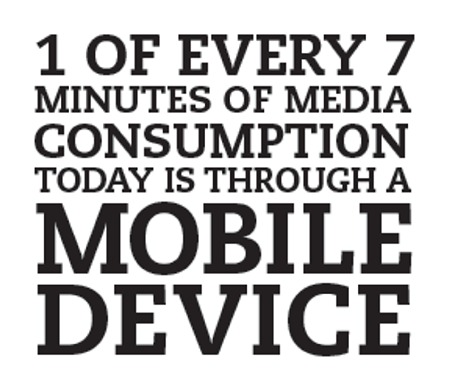
The mobile (smartphone) is transforming how we interact offline whether that is searching for services, brands or prices - we do it when we want, wherever we are. It is our access point to our social networks; our key communication tool.

If we add into this mix check-ins e.g. Facebook, ShopKick we can see how our online moments intersect with offline. Social commerce is not just a Facebook store or Facebook Open Graph integrated into a website; it is the influences upon our buying decisions.

Pre-sales: e.g. search, reviews, comments, likes

At the point of sale: e.g. offers, coupons, group buying

Post sale: e.g. sharing, commenting, rating

People are no longer shackled by access to the internet via a PC, it can be in the moment - it is real time interactions that will become increasingly important providing more relevance than before.

What will change this significantly is the integration and convenience of being able to pay using the mobile phone:

Looking at the Numbers


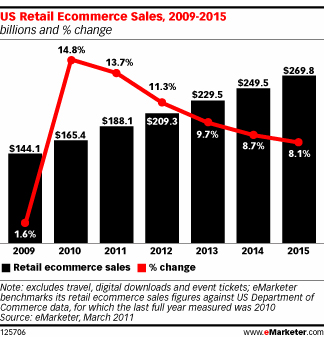
Here are some of the figures that demonstrate the continued growth of online:


The research firm Forrester projects online retail sales to increase to almost $250 billion by 2014. That’s a big number, but still a small piece of the retail pie at just 8% of U.S. sales.

Here are some interesting inforgraphics that support the changing dynamic of the social customer:

Blending the Offline and Online World


I’m fascinated by the impact of emerging technologies and how they influence economic variables across the media, marketing, information and entertainment ecosystem. In particular it is how the online and offline experience will integrate as brands seek to differentiate themselves.

If we take a look at retail we can see that at the moment it has several persistent problems: the high cost of attracting visitors, the low probability that they become buyers and the difficulty of getting them to come back. Sociable e-commerce offers potential solutions to all of them. So both brands and retailers must integrate their touch points to access customers.

Social business tools create experiences

It is no longer about channels; it is about the customer life cycle across everywhere a brand touches them. This involves orchestrating the customer relationship across touch points, not channels. It is mobile though that will bridge the gap between online and offline experiences, challenging marketers to connect the dots through creative solutions that match consumers’ mobile consumption habits. As brands give birth to creative ways to engage people their responses and conversations will also change how engage, brands will behave more like people and consumers will more than ever assess brands as they would people.

Is it Just about Facebook?

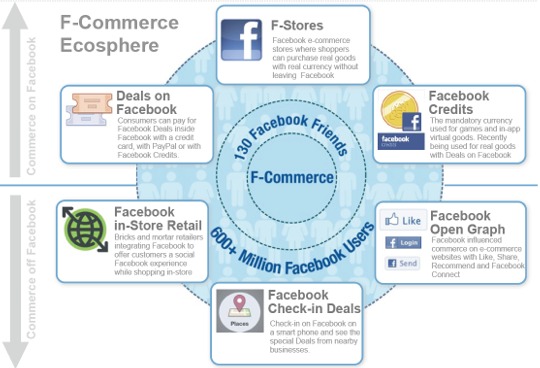
Facebook has extended its reach beyond the platform so that websites can integrate Facebooks Open Graph e.g. the 'Like'  and 'Send' buttons. Facebook’s business functionality will continue to evolve. Eventually, social elements will cross each function of business. Those businesses that are early to explore these methods will dominate what could become the largest market place: Facebook.


This illustration from Horizon Studios demonstrates the dimensions of Facebook commerce

Social Commerce

As e-commerce retailers continue to pop-up and online shopping becomes even more prominent, people will increasingly become more and more comfortable sharing transactional items like clothing, daily deals, books, and electronics as more of their purchasing decisions are made online. For the new generation of e-commerce firms, the offline world is as important as the online one.

New social platforms like Swipely will gain popularity.

Data the Oil of Commerce

Facebook captures vast amounts consumer data and this rich seam of data links personal data, network associations, transactions and location. It will drive yet further ways for brands to understand their customers. The very nature of the feedback mechanisms built into being a social brand provide the ability to fine tune product development, accelerate innovation and harness new technologies to drive engagement.

The potential to harness this data to deliver targeted, personalized shopping experiences for brands, is huge.

What are the building blocks


Businesses need to start small and simple-piloting, experimenting and reworking until successfully determining how to transform themselves into being social and agile businesses. Businesses that embrace this change to social commerce will reap the benefits of differentiation, reduced customer acquisition costs, lower service costs and faster time to market.

1. Integration

  • Get your channels in place. Set up Facebook and Twitter profiles – these are the main players.

  • Develop a mobile website, this is increasingly important and most websites do not render or work effectively on a mobile.

  • Use your mobile website to offer promotions, QR codes…many mobile website solutions like ours allow you to control this through a Content Management System that is easy to use.

  • ‘Socialise’ your website: add social media sharing links to your website.

  • Make it easy for people to share integrate social sharing with social sign-on so that items can be shared with the least amount of friction.


2. Facebook Page

  • Develop your Facebook page and build you fan page. If you haven’t established a Facebook page yet then don’t just rush in and commission a Facebook store you need to initially test and build you presence on Facebook, make sure it works for you.

  • Commission a branded landing page. Actively promote your products, promotions and discounts using email, Twitter and Facebook.

  • Understand how social your customers are: listen and engage customers to see how they react. Social is not for everyone.


3. Extend your capabilities

  • Enable sharing with friends before buying – to allow customers to crowd/friend-source advice on whether to buy.

  • Use a Social Shopping Cart which allows people to shop and share with their friends via Facebooks social graph.

  • Integrate Facebook comments into products; customer feedback is the essence of improving your range and products

  • Don’t just sell: social commerce shouldn’t be all about selling – add value to their customers’ shopping experience – and give them a reason for communicating with you and their peers.

  • Create a dialogue with customers who want to talk to you. Use your blog and social channels to do this.

  • Use your Facebook wall like it’s your shop window but don’t only broad cast – use it for feedback. Openly encourage customers to have a say in the business – by crowdsourcing decisions it will encourage how they promote you (word of mouth initiatives)

  • Integrate your customer service strategy with your social media strategy – diffuse situations by helping customers directly through social media.


4. A Facebook Store

  • Investigate bespoke solutions turn your Facebook account into a fully functional e-commerce platform.

  • Use Facebook contests that request “Likes” to automatically send users to the Facebook store to encourage product browsing.

  • Integrate your marketing and inform your current customers where to find your store and how it works.

  • Use the Facebook Fans API to combine promotions with links to product detail and purchase pages within the Facebook store - this enables brands to collect profile data. Add product videos – and host them on YouTube.


5. Promotions

  • Have a clear strategy and timetable promotions, make it varied and keep It interesting.

  • Don’t simply discount. Use virtual rewards as well as monetary ones - reward your fans with exclusive discounts and promotions.

  • Form alliances or partnerships with local businesses where you have synergies to promote each other.


6. Measure

  • It is important to use a number of different tactics to drive traffic to your website, develop referrals from social media and use offline tactics.

  • Measure and track how effective each is and use the information to refine and improve your marketing.

  • Use Facebook analytics to understand who is buying, who is being converted – use it to refine your marketing approach.


What do you think will be the deciding factors for being successful with online?

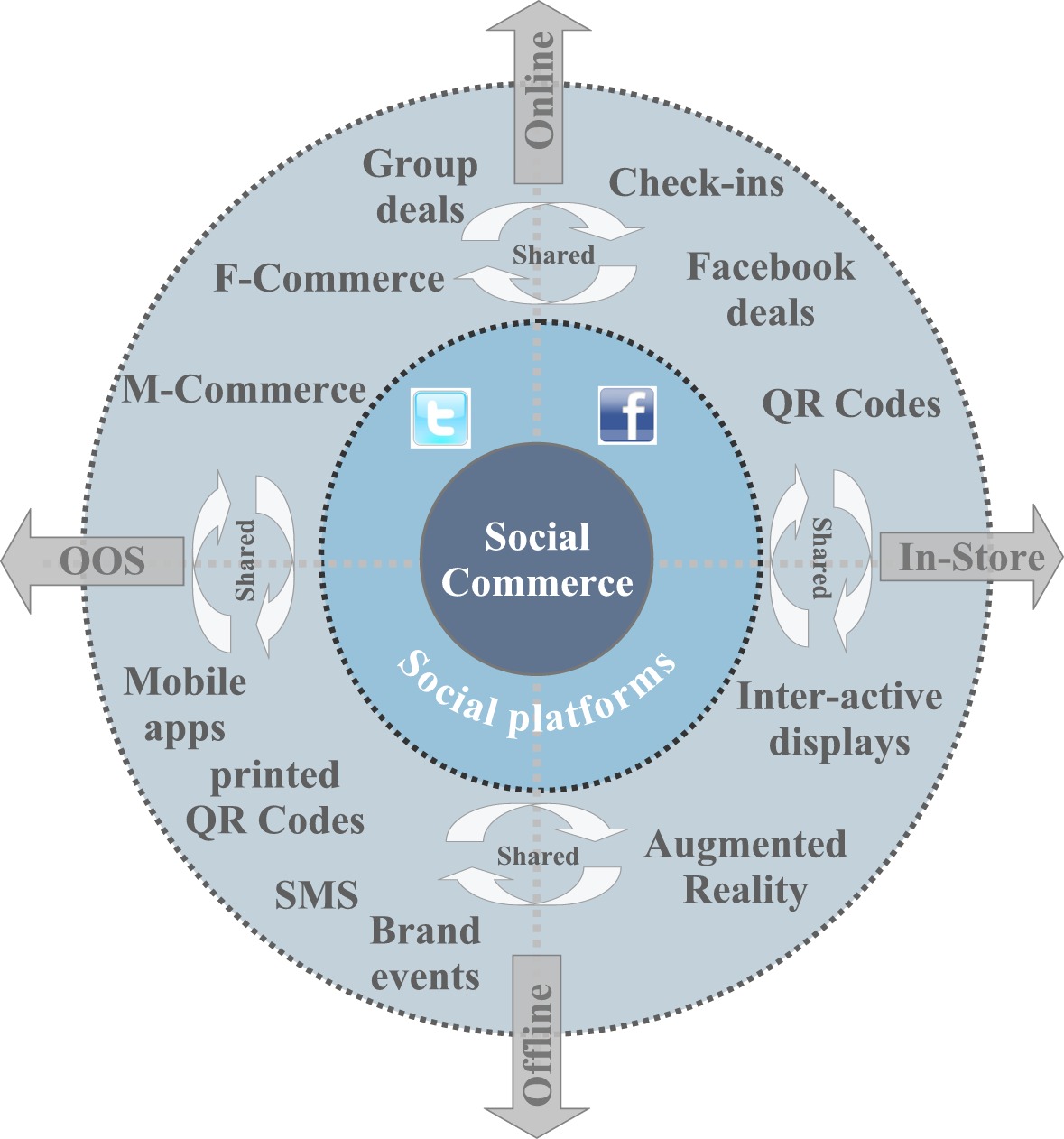
Integrating touch points


We produced a rough illustration of how some touch points and technologies integrate; it is not a model so much of an example of how each can play a part in how a business can use mobile, social and emerging technologies.


The Offline Experience


We can see how offline (this may involve connected devices but not your own 'device') experiences propagate online:

social commerce


sharing:


Tuesday, 1 February 2011

Customer Engagement - is it relevant?

Why is engagement so important?

The more engaged your customers the more content and word of mouth advocacy is generated and since people trust people this can attract new customers, develop sales opportunities and lead to sales.

Some communities take time to develop and this is where a clear strategy and engagement plan helps - see below for 4 stages of a community.

social media engagement


People have an identity, a voice and an ability to choose to listen or not to brand communications. Products are becoming commoditized, price differentiation is no longer sustainable and customers increasingly are more demanding.

Brands need to engage customers. Engagement is important for organisations because done well it can lead to web traffic, sales, and brand loyalty. On-line these outcomes can be measured and tracked against marketing communications and by channel. But what measures should be used and what is engagement really?

What is engagement?

“Engagement is turning on a prospect to a brand idea enhanced by the surrounding media context.” - Advertising Research Foundation definition.

“Engagement is an estimate of the degree and depth of visitor interaction against a clearly defined set of goals.”   — Eric Peterson

Here is a list of many more definitions.

Our preferred definition is “a consumer interaction with an aspect of a brand or media property.”

As you will realise there are many models and definitions. Forrester use a model called the 4'is and their video goes someway to explaining the importance of engagement.


However the 4i's don't readily explain consumer products that may not aspire to involvement and focus on influence. Conversely, a hotel brand needs to make sure intimacy and influence are optimized over interaction.

Social Media Engagement

We have produced a scale that reflects how users develop their engagement over time and reflects their interactions both online and offline e.g. if you are a passionate Harley Davidson owner you may be active on-line, but may also attend offline events and possibly help organise them. For Adobe you might dedicate time to developing tutorials and tips for other people and share these on-line whilst hosting off-line training days. For more information of measures check our earlier posts on ROI.

The Value of Engagement

As organisations look for ways to develop their brands,

the main question arises of how engagement relates to acquiring and retaining customers. Clearly brands not only want loyal customers but they also want those customers to tell their friends about the brand about how good it is (and post good reviews, generate positive sentiment, produce content....); the new goal is advocacy.

By developing a brand community organisations can listen to their customers, communicate easily, reward contributors, gain data and insights and shorten product development life-cycles by sourcing feedback form the community. However, in order to earn peoples trust and develop the relationship brands must participate alongside their customers openly and transparently, and deliver value.

Organisations are placing more value on understanding people’s behaviour, passions, interests and ideas. This broader context of society and networks moves brands from a model of manipulating messages to purchase to facilitating solutions and experiences; from campaigns to relationships.

What is the benefit of engagement?

The Engagement db study evaluated the top 100 brands and their use of social media. Brands were rated more "engaged" by the more channels they participated in, and the depth of engagement within that channel. The report shows how engagement varies by industry.


What does this mean? Well clearly some industries are not actively using social media to engage with their customers e.g. Finance and may be facing challenges with how to use these effectively inside and outside the organisation.

For those organisations that are actively using social engagement there is a causal relationship to their financial performance. The key take out here is that those transitioning there marketing to social engagements and building communities develop more profitbale customer relationships.


Other reports that relate to this are:

1. How much is a Facebook customer worth

2. Some Social Media & Marketing Case Studies

Brands need to get closer to identifying how to develop user experiences that matter, but not just to trigger emotional responses to buy. This is manipulation for short term gain whereas moving from campaign to community develops sustainable relationships These depend on service, reputation, continued development of insights and facilitating customer solutions.

What are the trends that will affect customer engagement?


How can this be used?

It is important to understand how engagement fits within the overall social business strategy. Firstly it is worth researching and benchmarking your current position; what interactions take place and in what channels, who are the customers….

Aligning objectives to what experiences and solutions can be developed is a key starting point. Remember it is about customers first not your business. Use the insights from understanding customers to bring clarity to your content strategy – this is the fuel of engagement. Set out clear measurements and map your budget against where you can effectively develop your touchpoints with your customers. Monitor customer behaviour and engagement on an on-going basis to analyse what is working well and what needs to change, make this a continuous improvement process so that you are in touch with how your customers are changing in this fast paced landscape.

Challenges

Forrester Research noted in a recent study that “Marketers must wrestle down the numerous

data sources to capture the presence, value, impact, and degree of customer interactions across

channels.”

There are many potential metrics and these will need to be chosen based on your specific engagement strategies, media and channels. A key point is to keep it simple, easy to measure and stick to basics as a first step.

Organisations need to move away from campaign transactions and think strategically about share of wallet, share of lifetime - good brands recognise the long term benefits relationships can yield. Now is the time to build your brand community, your tribe.

Sunday, 23 January 2011

5 steps to start your social business strategy

Why focus on integrating social business technologies?


The trends have been discussed and explored, the case studies are readly available and the technologies are proven - now is the time to invest and build capabilities for a social business.


McKinsey highlights the case that adoption is critical for organisations to become social businesses. The simplification of integration, lower costs and adaptive systems create a rational for change that is undeniable; social business is the focus for 2011.

Benefits of being a social business:

  • Increasing internal efficiency and knowledge collaboration

  • Improved customer relationships

  • Improved innovation through customer participation


But it is the need to adapt to changing customer behaviours and maintain mind share in congested markets that is driving much of the change. Let's revist some of the trends that are happening that affect how organisations market to customers.


Many organisations are still grabbling with how to use social media to engage their customers, but besides a few leading brands many are failing. But why? Well one of the main reasons is that in changing over to social media many are still broadcasting information and not engaging in developing a relationship. For others it has to date been a tactical dip in the water often isolated from the main organisational strategy.

Organisations now need to recognise the greater impact of a social business strategy to engage customers and unlock value.

5 steps in developing a social business strategy


The American Marketing Association (AMA) article on social business design, highlights the changing nature of work, a shift to cultures of sharing, and evolution of personal technology create emerging market opportunities. It points to a social business strategy.

1. Learn first - Explore

To start with, an organisation and key stakeholders should use an expert to quickly get up to speed with the technologies and how they are being used.  A good consultant can deliver this and at the same time focus on your industry and/or market and what is relevant. Also use and involve people in the business who are interested and knowledgable. This is the explore stage of developing a social business strategy.

2. Framing and developing the questions

Develop the questions that apply to the organisation. These lay the foundations for developing a strategy and will help to prioritise any research needed. Involve key stakeholders in formulating the questions; some people have different perspectives, roles, knowledge and skills. These all add value at this stage. As a team prioritise them and sort them into long term and short term.


Here a few key questions as examples:

  • How are our customers using these social technologies

  • What markets/products and customers should we focus on

  • What internal changes might be needed

  • How do these technologies change our business model


3. Benchmark the business

Many of the questions that around strategy often relate to markets and competitors. We have in an earlier blog covered some of the key tools for social monitoring. However here are some further reports and information that may be useful:

Why benchmark your brand/business? Benchmarking helps you understand your market, competition and provides you with recommendations to differentiate. A good benchmark report will provide strategic options towards developing a competitive advantage. A benchmark report can be used to understand where your customers are, who are key influencers, their interests...It can be the start point for understanding how you are going to measure your business.

4. Identify the opportunity and invest

Choose a project that can deliver some tangible wins. If it is marketing to your customers, then consider that the ultimate goal is to focus on the long term aim is to build a community around the brand and delivering sustainable value. This means tactically building on each promotional campaign to develop the brand community rather than disposing of customer data and assets each time. This then engages customers in each stage of the brand journey.

A critical part at this is to set the goals, objectives and review the measures that you are going to use. We dealt with the ROI measures that can be used in an earlier blog.

5. Content, Quality and Engagement

Content is the reason your customers come to you, the reason they will connect emotionally with your organisation or brand. However, in todays digitally diverse world many organisations under estimate the time, effort and cost of good quality content. The content strategy is vital and should be thought of early. Multi channel communications must have consistency to reinforce each other and produce a unfiying customer engagement.

Managing and producing content is becoming increasingly difficult due to the technical skills required.

Key tips

  • Know Your Voice - Everything you say on the social web should “sound” like your brand

  • Time Your Content - Create a calendar that spells out what you’re going to pproduce and when you’re going to publish

  • Add value - Know your Customer. Why does somebody follow you? Why do they like you? It’s because your brand offers them something; understand this track it keep it fresh.

  • Solve Problems - Humans have survived for so long because they’re great at answering questions. Work collaboratively with your brand community to solve their problems, help with their interests...

  • Be True - Good content isn’t fake. It doesn’t make promises that it can’t keep. It’s human and honest and that is why it makes a human connection with its audience.


As with any business the more time and energy that is spent at the planning stage improves upon the execution. It is about being great, delivering to high standard and implementing well and a good strategy determines much of this.

Be Agile

In today's changing world organisations need to adapt continually. The days of annual long range plans are gone. Scanning the environment, brnging on board intelligence and then adapting plans are vital to success. So set the goal of becoming agile and adapting to stay ahead.
Social media and agile leadership
View more presentations from TribalCafe.


Saturday, 15 January 2011

Social Business and Strategy Thoughts

What is a Social Business Strategy?


A strategy is quite simply it is the long term plan on what to do to achieve a goal.

A good strategy defines a very clear route on what an organisation is looking to achieve and answers the question on how it will do this. A social business strategy then is focused on how an organisation is to integrate social technologies to help it achieve its goals. There are two areas of opportunity for an organisation; to improve performance and productivity internally and to improve customer engagement externally.

To make some decisions then about a social business strategy organisations have to think about how the context of these within their business and the fit to their customers. Before deploying resources (people, money...) some key questions need to be answered...e.g.  how will these technologies affect our business model, what new models will evolve...

How do we develop a social business strategy?


If you understand your business goals then aligning a social business strategy to your goals becomes easier. For most organisations the primary need is to effectively integrate social technologies into marketing to their customers. But targeting how you are going to do this requires some research. Why? well there are a host of reasons here are a few:

  • You need to differentiate your product/service and have a unique proposition/strategy compared to your competitors

  • Because the more you understand your customers the better chance you have of finding unique ways to interact with them, engage them and add value to your communication.

    • The aim is to understand who your customers are, where they are and what they are interested in, what problems they face, what behaviours they exhibit, what they think about your type of products/services...


  • The best marketing insights come from research and then provide unique ways for genuine customer engagement

  • If you know your market better than your competition chances are you will have a competitive edge; be able to change faster and adapt.

  • If you understand your current position ve. competitive brand you will have a benchmark point from which to improve and understand how to set a strategy tht creates a tangible point of difference.


Where to start?


This all depends on the size of your oganisation, structure, culture...but an initial opportunity is to identify what is being said about your brand/business/product or service on the network. Many tools exist from simlple to more complex.


Our Blog on Social Media Monioring Tools covers many of the main free and paid for tools that you might use. But in order to start with you need to set yourself some objectives for what you are going to listena for and research.

  • Define an Objective

  • Decide where to monitor

  • Decide what to monitor

  • Match your requirements to the right technology (social monitoring tool)


The online landscape is saturated with more than 200 tools and platforms claiming to be able to help you track and assess mentions of your business or brand in social media channels. While there remains a lot of churn in the field, a number of listening platforms have evolved to help you go beyond basic monitoring into an integrated approach that helps inform multiple parts of your business: product development, customer support, public outreach, lead generation, market research and campaign measurement.

social business, social media, social technology, marketing, crm

Many organisations have now got beyond the question of the need to apply social technologies and now need to answer the questions of how to integrate these. In moving to a social business they recognise that they do not have the skills. Importantly the questions that they need to strategically answer and the research needed sit outside their scope and so they need to partner with an agency.

For others that have already tested solutions scale and integration become critical; but scale often means setting a strategy to migrate from legacy systems. However, the strategy needs to be set for initially integrating solutions into CRM, marketing and sales solutions for marketing, customer service and sales.

Some of the challenges facing organisations today are how to :

  • Integrate solutions in the enterprise space for CRM

  • Building internal capabilities and teams (training, education and recruitment)

  • Work across divisions and departments to develop projects - traditionally it is marketing that has led social media strategy but now internal communications, PR, customer service... need to be involved.

  • Develop business model/stakeholder by-in and ROI

  • Develop clear marketing strategy including integration into website - see below (click to enlarge).


What do you think the big challenges are now?

How well are organisations researching and setting their strategies?

Friday, 14 January 2011

The Top 20+ Social Media Monitoring Tools

Why use Social Media Monitoring Tools


Social media monitoring tools enable organisations to listen to the many  conversations that people have online. With the explosion of social media channels and the volume of conversations from Facebook to Twiter means that there is a lot of data.

the reason that many organisations want to understand these conversations is because people are discussing brands, describing their attitudes and feelings about them, as well as their intention to possibly buy. In many cases as well though brands are also facing into the fact that these social channels are now also where customers are complaining and so a new customer service channel has opened up whereupon brands now listen and address issues customers might have.

The opportunity for organisations is straight forward they need to be listening to and part of these conversations to develop customer relationships and to manage reputation. They can now listen-in on the conversations of their customers, potential customers and other stakeholders in a way that was previously impossible. By using social media monitoring it is possible to develop insights from the conversations people are having online every day and to make improvements to products, customer service and marketing as a result.

With the social media monitoring tools organisations can effectively  measure the impact of their marketing and so develop key metrics to measure performance of social media campaigns. With have gathered together some information on social media monitoring tools for you no matter what your need.

Some of the benefits of social media monitoring:

  • Research key influencers and groups by chanenl and community enabling deep and different behavourial understanding

  • Customer service teams can listen out for customer issues online and then and resolve them; especially when integrated through API's into their CRM systems

  • Understand competitors marketing and key influencers. This means that marketing departments can find out what customers are saying about competitors’ products.

  • PR Managers can quickly respond to reputational issues, potential PR disasters before cause any long term damage or spread across the social network.

  • But fundamentally it also allows organisations to understand the epp and flow of interests and topics that are relevant to their customers. This then can lead to innovative ideas for developing new products and services.


But first we will exaplin a bit about the terminology that sits around the social media monitoring.

Terminology


There are few terms you’ll need to be familiar with before we talk about the tools, so let’s take a moment to cover them before we jump into the details.

Influence


If you find there are customers who have a strong opinion of your brand, it’s important to understand the influence of those customers.

  • How many followers do they have?

  • Do they get retweets?

  • How many external links point to their blog?

  • How many comments do their blog posts attract?


Several of the free tools listed below include this measurement to assist in your monitoring and response efforts. All of the paid options include it.

Sentiment


Are the comments positive or negative? Most current tools attempt to assign sentiment to a post automatically. While this is helpful for brands with tons of mentions, it’s only about 70% accurate in most cases, so manual verification and spot-checking is encouraged across the board before making any decisions based on influence data.

Volume


This is simply the amount of "buzz" that exists. Many monitoring tools give the ability to chart volume for specific keywords over time. This gives you a great way to measure the impact of your marketing efforts and social media campaigns, especially when combined with sentiment. A lot can be learned about your brand and your customers by investigating spikes in social media volumes.

Workflow


Workflow is the process of assigning, tracking and responding to social media, typically in a team environment. An effective workflow can prevent double responses and missed opportunities.

Now that we have an understanding of the purpose and the terminology surrounding social media monitoring, let’s take a look at some tools that can help you monitor your presence.

We have listed below the main Social Monioring Tools

DEEP ANALYSIS TOOLS


Radian6


Cost: The dashboard starts at $600/month, though registered nonprofits can apply for two free uses per year under the company’s Giving Back program.

Radian6 features an Engagement console that lets you listen, engage, and plan in one handy desktop application. Monitor the performance of all your brands, services, and keywords across every social network platform simultaneously. This is the powerful solution that will propel your business to the next level. For example, radian6 does not limit itself to the major social media platforms: it extends performance searching to include blogs, forums, photo and video sites, comments, and millions of other sites on the Web. radian6 aggregates data from all across the Internet, filters and segments it, and reports and charts it for you based on a host of user definable and selectable metrics.
social business

Alterian SM2


Cost: Pricing is based on volume of results and ranges from $500/month to $15,000/month. “Freemium” trial plan allows for five keyword or phrase searches and a total of 1,000 results.

With marketing agencies in mind when SM2 was designed, you get relevant performance data from social media platforms that helps you make the most out of your marketing time and money. Find out who’s happy and who’s mad about you, your company, and your products. Gauge the effectiveness of your social media marketing and use the information to design your next campaign. Special features of SM2 include a custom workflow tool, language and geographic filters, as well real time alerts. Try the free version or pay by the volume of results.

social business

Lithium


Cost: Base plan of $249/month for five users and five searches. Free 14-day trial.

Lithium monitors your search-specific mentions and sentiment in social media outlets and outputs them into easy-to-read graphs and numbers resembling the stock market. Lithium will aggregate information from a variety of platforms including blog posts and comments, Twitter, Facebook, Flickr and many others, and it’ll assess emotions surrounding your brand pre-, mid- and post campaign so you can adjust your strategies accordingly

social business


Attensity360


Cost: $399/month for one license. Discounts for longer subscriptions. Free 15-day trial

Attensity360 operates on four key principles: listen, analyze, relate, act. Attensity360 will help monitor trending topics, influencers and the reach of your brand while recommending ways to join the conversation. Attensity Analyze applies text analytics to unstructured text to extract meaning and uncover trends. Attensity Respond helps automate the routing of incoming social media mentions into user-defined queues.

social business

MODERATE TO LIGHT TOOLS


Addictomatic

Addictomatic searches the best live sites on the web for the latest news, blog posts, videos and images. It’s the perfect tool to keep up with the hottest topics, perform ego searches and feed your addiction for what’s up, what’s now or what other people are feeding on.

Backtype
BackType is a real-time, conversational search engine. We index and connect millions of conversations from blogs, social networks and other social media so you can find out what people are saying about the topics that interest you.

Blogpulse Trend Search
Create graphs that visually track “buzz” over time for certain key words, phrases or links. Compare search terms/links in isolation, or use all three fields to compare search terms/links against others. Type your search terms in the boxes on the left. Type descriptive labels for each search into the boxes on the right. Then choose your time frame: 1, 2, 3 or 6 months.

Blogpulse Conversation Tracker
When a blogger publishes a post and other bloggers link to it, the original post ( or “seed”) becomes part of a conversation. From those seeds sprout links, and so and and so on, until it creates an entire conversation. The nodes of the graph are posts and the arcs of the graph are permalink citations from post to post.

Boardreader
BoardReader can be used to find and information on the forums and message boards. Boardreader uses proprietary software that allows users to search multiple message boards simultaneously.

BoardTracker
A search engine in the ‘traditional’ sense. All the information in our database is from forum threads only, all extraneous text on a page is excluded by default which allows use to return even more relevant results without the ’spam’. Corporate users can arm their sales and marketing staff with


Google Blog Search
Blog Search will help users to explore the blogging universe more effectively. Whether you’re looking for Harry Potter reviews, political commentary, summer salad recipes or anything else, Blog Search enables you to find out what people are saying on any subject of your choice. You can select the time frame for the posts and set up alerts.

Google Insights for Search
Google Insights for Search analyzes a portion of worldwide Google web searches from all Google domains to compute how many searches have been done for the terms you’ve entered, relative to the total number of searches done on Google over time. It also predicts the future for one year.

Google Keyword Tool
Keyword Tool gives you insight into interest levels of different topics. It also suggest alternative words and phrases that might be tied to your filed of interest. You can segment results by location or language.

Google Trends
Trends allows you to compare search terms and websites. With Google Trends you can get insights into the traffic and geographic visitation patterns of websites or keywords. You can compare data for up to five websites and view related sites and top searches for each one.

GraphEdge
GraphEdge helps you make sense of the Twitter. How many of your followers you’re really reaching? How quickly your network is growing? Who’s dumping you? Who your most influential followers are, and how to reach them?

HowSociable
Free monitoring tool for measuring your brands or keywords using 32 social networking sites.

Icerocket
Trend Tool, enter up to five items to see mentions trended over time. Search feature finds blogs that mantion the phrases you enter.

Klout
Klout measures influence on topics in Twitter to find the people the world listens to. It analyzes content to identify the top influencers on given topic.

Monitter
It’s a twitter monitor, it lets you monitor the twitter world for a set of keywords and watch what people are saying. Just type three words into the three search boxes and within seconds you’ll start seeing relevant tweets streaming live.

Omgili
Omgili Buzz Graphs let you measure and compare the Buzz of any term. The Buzz is the percentage of the term out of the total number of discussions Omgili covered on a specific date.

Quarkbase
You can find out how good a site is, get comprehensive website details, discover competitors and analyze them. One can call Quarkbase ‘whois on steroids’ or ‘imdb for websites’, which provides detailed website information like people, traffic, similar sites, social comments, description, social popularity and much more.

Retweetist
Find out who is retweeting you or other Twitter users. Discovering trends, popular topics and popular people by tracking retweets across Twitter.

Samepoint
Samepoint crawlers encompass every conceivable type of social media service. Our categorization breaks out results by type of social media.

Social Mention
Social Mention is a social media search and analysis platform that aggregates user generated content from across the universe into a single stream of information. Social Mention monitors more than a hundred social media properties including: Twitter, Facebook, FriendFeed, YouTube, Digg, Google.

Surchur
Surchur is the ultimate dashboard to right now. The surchmeter shows you how popular a keyword is on different sources: surchur, blogs and twitter.

Technorati Search
Search Technorati and note the authority and rank of the blogs listed in the results. Authority measures the site’s standing and influence in the blogosphere. Rank shows what position this authority gives the site.

Topsy
When you search on Topsy it finds snippets of conversations that match what you’re looking for. The results are the things people link to, when they’re talking about your search terms. Results are ranked based on how well they match your search terms, and the influence of the people talking about them.

Trackur
14 day trial. Trackur is an online reputation & social media monitoring tool designed to assist you in tracking what is said about you on the internet. Trackur scans hundreds of millions of web pages–including news, blogs, video, images, and forums–and lets you know if it discovers anything that matches the keywords that interest you.

Trendrr
Trendrr allows you to track the popularity and awareness of trends across a variety of inputs, ranging from social networks, to blog buzz and video views downloads, all in real time. You can compare trends to one another, monitoring and evaluating this comparison across a variety of sources. Free for 10 trends

Trendpedia
Trendpedia finds the articles online that talk about your topics and organizes the articles in a trend-line that shows the popularity of the topic over time — you can track a topic’s trend-line from three months ago up to today.


Tweet Scan
Tweet Scan searches Twitter, identi.ca and other Status.net-based sites with more being added all the time. You can search public messages and user profiles with results available via email, RSS, and JSON.

TweetVolume
Enter words and phrases to find out how often they appear in tweets. Compare up to five different keywords.

Twitalyzer
There are a variety of uses for the Twitalyzer, but most people use it to track their use of Twitter over time, benchmarking themselves against other Twitter users, and helping to determine which social media strategies are working (and which are not.)

Twitrratr
Twitrratr built a list of positive keywords and a list of negative keywords. It searches Twitter for a keyword and the results are cross-referenced against adjective lists, then displayed accordingly.

TwitterCounter
Track your Twitter follower count up to three months into past. Compare your numbers with other Twitter users. You can also see statistics of whom you are following and your tweet frequency.

Twitter Grader
Twitter Grader is a free tool that allows you to check the power of your twitter profile. It looks at a variety of factors including the number of followers, power of those followers and the level to which you are engaging the community.

Twitter Search
Searching Twitter gives you insight into what’s hot at the moment and helps you find who is tweeting about the topics you are interested in. Advanced search lets you specify dates, languages, people and even attitudes.

Twitter StreamGraphs
The Twitter StreamGraphs is a content visualization tool to let you create StreamGraphs from the latest tweets containing a given word or from a particular user.

Twitturly
Twitturly tracks the URLs flying around the Twitterverse and provides a quick, real-time view of what people are talking about on Twitter. Each time someone tweets a URL to their followers on Twitter, Twitturly takes note of it and applies it as a vote for that URL.

Twendz
Twendz gives a glimpse into what’s on people’s minds and their emotional reaction. Mining Twitter conversations alerts you to brewing trends, conversation topics and points of view.


Usernamecheck
Does wht it says. Check your user name across 68 social networking sites.

What’s the Buzz?
Type in a keyword below and find the buzz about it in blogs and social bookmarks. It displays the Technorati Blog Popularity Chart, showing how popular the keyword has been blogged about in the past 90 days and the Google Trends chart for the keyword. It finds blog posts tagged with and containing the keyword. It finds social bookmarks tagged with the keywords

YackTrack
Enter what you want to see comments for and f there are comments on any of our supported services, you should see them.